
BOP Menominee Release Path
No BOP institution was identified in Menominee County. The federal system appears because a defendant may pass through local or contract custody before sentencing or transfer. Menominee County Jail can record the end of its own custody, but that county movement cannot establish the end of federal authority. Once a sentenced person enters BOP, the BOP locator and federal court record become the main public paths.
Three layers must stay separate. USMS generally manages federal pretrial custody and prisoner movement. BOP holds sentenced federal prisoners and publishes the locator. A federal court judgment and docket record the sentence, later orders, revocation matters, and any term of supervised release. Supervised release means court-ordered monitoring after imprisonment; it is not BOP prison custody.
| Federal layer | Role | Public route |
|---|---|---|
| USMS | Pretrial custody and federal movement | Agency or court inquiry; no public name locator |
| BOP | Sentenced federal prison custody | BOP Inmate Locator |
| Federal court | Judgment, sentence, orders, supervised release | PACER docket |
| ICE | Separate civil immigration detention | ICE ODLS |
Search BOP Release Records
The official BOP Inmate Locator generally covers federal inmate records from 1982 forward. Search by an exact number when possible. The system accepts BOP register, FBI, DCDC, or INS numbers. A name search also offers demographic filters, but identity must be checked against the result rather than assumed.
- Choose the number search when a verified federal identifier is available.
- Otherwise enter the full name and use race, sex, and age to narrow the candidates.
- Compare the full identity and register number before relying on a row.
- Read the location, status, and release date exactly as BOP displays them.
- Check the federal docket for the judgment, sentence changes, and supervised-release term.
- If the person is not in BOP custody, test USMS, state, local, or ICE custody when the facts support another system.
The Menominee County release-search overview helps route a case when the last agency is unknown.
BOP Federal Release Locator
The matching manifest image shows the official federal locator used for BOP custody history. It is not a Menominee County jail roster and does not cover every federal pretrial detainee.
Open the official BOP locator and its number or name search.
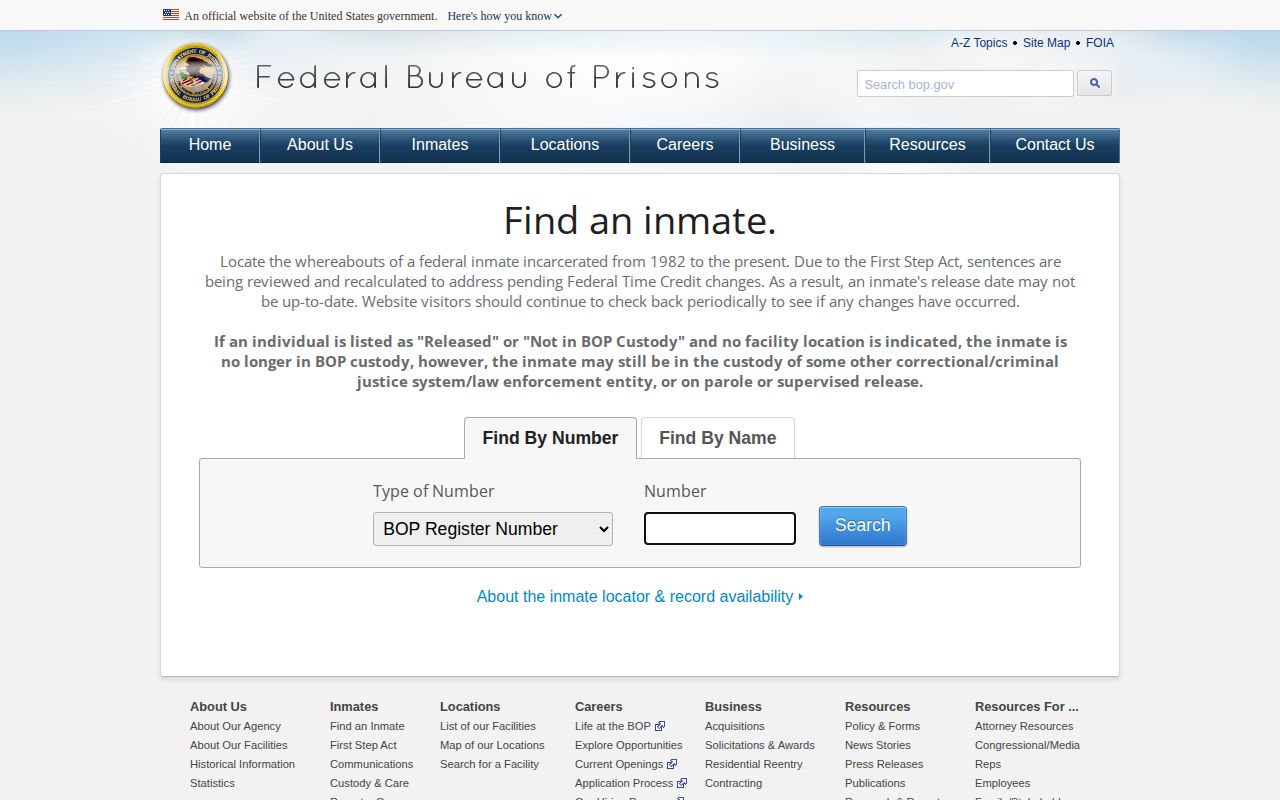
The search form supports a federal-history check. The result still needs the federal case record to explain sentence and post-prison supervision.
A historical row can provide a release date and indicate that the person is no longer in BOP custody. That confirms a BOP record event, not the absence of a pending warrant, a state sentence, ICE custody, or supervised release. Preserve the register number and access date so a later request can identify the same person.
Read BOP Release Results
A BOP release date answers when the person left the displayed federal prison episode. It does not always explain why, where the person went, or whether the date reflects a completed sentence, another lawful placement, or a record status with limits described by BOP. Use the locator’s own wording rather than replacing it with a broader claim.
- BOP custody
- Federal prison custody administered by the Bureau of Prisons for a sentenced person.
- Federal pretrial custody
- Custody before final disposition, usually within the U.S. Marshals Service role.
- Supervised release
- A court-ordered period after imprisonment, enforced through the federal court and probation system.
- Detainer
- A request or legal hold that may cause transfer to another custodian when one agency’s authority ends.
A missing result also has limits. The record may predate broad locator coverage, the name or identifier may differ, or the person may never have entered BOP custody. Someone held only before trial may be within the USMS role. A state or local sentence belongs in that system, not in BOP. Do not convert no result into proof of release.
Federal Court Release Record
PACER is the official federal court docket route. Registration and document fees may apply. The judgment identifies the prison term and supervised-release term. Later docket entries can reflect sentence changes, revocation, an amended judgment, or another order that changes how the BOP date should be read.
The court record and BOP movement serve different roles. A judgment can authorize and describe the sentence, but it is not a live movement log. The locator may show a release date, but it does not replace the judgment’s terms. Match the defendant, case, register number if present, sentence, and dates across both systems.
For a Menominee County link, MiCOURT is not the federal docket. A local court entry may explain a state or county matter, but a federal criminal case belongs in the federal court system. If both local and federal cases exist, each may create separate custody or supervision obligations.
BOP Release Record Requests
BOP’s locator is the public first step for a sentenced federal prisoner. When an official record beyond the locator is required, identify the person with the verified register number, full name, and date range. Ask the appropriate federal office for a named existing record rather than a newly compiled answer. The federal court clerk or PACER supplies filed judicial records; BOP controls its prison records.
The USMS prisoner-operations source explains its pretrial custody role but does not offer a public person-name release database. A pretrial inquiry may therefore require the federal docket and an authorized agency contact. Do not expect Menominee County staff to certify federal status after their own movement record shows a transfer.
Privacy and access limits can apply. A public locator result is not the same as unrestricted access to every prison file, medical detail, security record, or supervision term. Keep the request tied to custody and release verification and preserve the exact agency language received.
Federal Bureau of Prisons correctional systemNo BOP institution identified in Menominee County
Public access: BOP Inmate Locator
Federal case access: PACER
Menominee Federal Transfer Check
A person can leave Menominee County Jail on a federal writ or detainer without entering the community. The county movement entry should be requested with the destination or receiving agency if recorded. If it names USMS, that is a federal custody handoff. If later sentencing leads to BOP, the federal locator becomes relevant. If the person was returned to local custody after a court appearance, neither movement should be mislabeled as final release.
Likewise, “released from BOP” can be followed by another custodian. A state warrant may cause state transfer. An immigration matter may lead to ICE. Federal supervised release can begin in the community. Each outcome uses a different record, so one status screen cannot resolve them all.
The strongest chain has three parts: the sending agency’s movement entry, the receiving system’s record, and the court order that explains authority. When all three agree, the federal release statement can be made with precision.
BOP Historical Release Limits
BOP says its locator generally contains federal inmate information from 1982 to the present. An older sentence may fall outside that online range. Historical information can also require a records or archive route. Save the precise query and identifiers before concluding that a record is absent.
Name-only matching is risky. Use a verified register number whenever possible and compare demographic data. Do not select a person because the name merely resembles the intended defendant. The federal docket can supply identifiers and sentence context that help distinguish candidates.
Dates can also differ across records for sound reasons. A judgment date, sentence start, projected date, transfer date, BOP release date, and start of supervised release do not describe the same event. Copy the label with the date. If two records seem inconsistent, compare the sentence, later amendments, jail credit, and record update dates before asking the responsible office to resolve the difference.
Menominee County’s role may end well before the displayed federal release. The county record can show when its jail transferred the person, while BOP later shows the end of federal prison custody. Keep both events in the timeline. A long gap between them is not an error if the federal sentence continued at an institution outside the county.
A release date is strongest evidence for the end of BOP prison custody. It is not a finding about every legal obligation. Check the judgment for supervised release and any later docket event. If another custodian is plausible, use that agency’s system. This keeps a Menominee County federal inquiry tied to the actual custody chain.