
Menominee Parole and Probation
Parole and probation both let a person live in the community under rules. Their legal roots differ. Parole follows release from a Michigan prison sentence and is tied to a Michigan Parole Board action or the controlling statutory process. Probation is imposed by a trial court. It may follow a jail term, form part of a split sentence, or begin without state prison. The Menominee County Jail cannot settle an ongoing state-supervision question just because the original booking happened there.
The Michigan Department of Corrections, or MDOC, supervises people shown in its records as parolees or probationers. The sentencing court still matters for probation. Menominee County’s 95A District Court handles misdemeanor cases, while the 41st Circuit Court handles felony and general-jurisdiction criminal matters. An order from the right court explains the term and any later violation or discharge. OTIS supplies the public status and place of supervision.
| Point | Parole | Probation |
|---|---|---|
| How it begins | Release from a state prison sentence under MDOC supervision | A sentence ordered by the District or Circuit Court |
| Public status | OTIS may show PAROLE and a DATE PAROLED | OTIS may show PROB when MDOC supervises the case |
| Key record | Parole order, OTIS record, and later discharge record | Judgment, probation order, court register, and OTIS where covered |
| End point | MDOC discharge after the controlling obligation ends | Court or agency discharge under the individual order |
- Parole
- Conditional release from state prison while MDOC supervision continues.
- Probation
- A community sentence imposed by a court, sometimes after a jail term.
- Discharge
- The end of the shown MDOC term or supervision obligation.
- Absconder
- A person the supervising authority says has failed to remain available or comply.
Check Menominee Supervision Status
The official starting point is MDOC’s Offender Tracking Information System, known as OTIS. It covers current prisoners, parolees, probationers, absconders, and qualifying recent discharges under MDOC jurisdiction. It does not cover every Menominee County Jail stay. A person who served only local jail time may have a court probation record without an OTIS history, so a negative result must be read with care.
- Search by MDOC number when known. It is the strongest public identity key. Otherwise, use full name and the available age, status, or other filters.
- Match the candidate by name, age or date details, photograph, convictions, sentencing county, and MDOC number. Do not select a record from name alone.
- Read the status exactly.
PAROLE,PROB,DISCHRG, and an absconder status have different meanings. - Record the place of supervision and any
DATE PAROLED. That date can show prison exit, while parole status means supervision has not ended. - Use the MDOC office directory to confirm the office shown by the current record. Office lines and agent assignments can change.
- Check the proper Menominee court record when the question concerns a probation order, violation, revocation, or court discharge.
Public verification should remain at the level the agencies publish. Reporting times, addresses, treatment details, and case-management facts may be confidential or safety-sensitive. The public record can confirm the broad status and office without exposing those details. For the full county release path before supervision begins, use the Menominee County released inmate search.
MDOC’s parole and probation page shows the official supervision and office-lookup route.
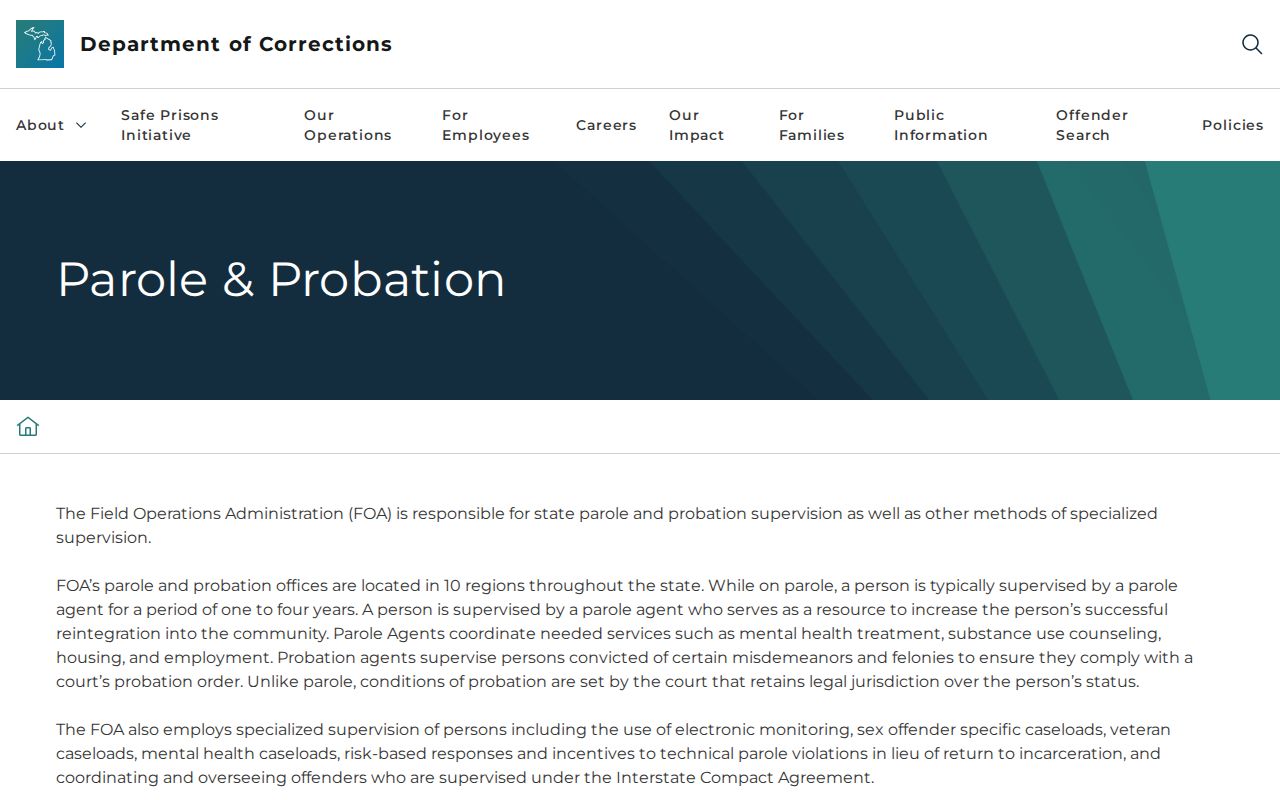
The image helps distinguish an MDOC office search from a county jail release inquiry. Each office serves state supervision, not Sheriff booking-record requests.
Menominee Supervision Office
MDOC’s Region 1 directory identifies a local office for Menominee County. Use it after OTIS shows parole or probation and lists Menominee as the supervision location. It is the practical contact for a public status or location correction. It should not be treated as the source of the Sheriff’s release form, because county jail and state supervision records belong to different custodians.
Menominee County Parole/Probation Office1000 9th Street
Menominee, MI 49858
906-863-4705
Office boundaries and agent assignments can change, so check the state directory before relying on an older contact. When the public OTIS entry and an old paper record conflict, state the MDOC number, exact displayed status, and place of supervision when calling. Ask for confirmation at an agency level. Do not seek private schedules or personal case details.
Menominee uses Central Time, unlike much of Michigan. The research does not publish office hours for this local supervision office, so call before a visit instead of assuming Lansing’s Eastern Time business hours apply.
Note: The Menominee office verifies state supervision, while the Sheriff and county administration hold local jail and release records.
Menominee Absconder Record Checks
An absconder status is not discharge. It means the authority alleges the person failed to remain available or comply and is wanted in connection with supervision. OTIS permits a statewide search with the Parole Absconders or Probation Absconders status filter, even when no name is entered. Those results serve a public-safety function. They do not establish where a person is now.
MDOC describes ABSCOND1 as a parole absconder actively sought by the department. The place shown is the last supervision location, not a current location. ABSCOND2 is a probation absconder under the sentencing county’s jurisdiction. If current whereabouts are known, contact local law enforcement. MDOC also publishes an Absconder/Escapee Tip Line at 517-755-0855. Never approach the person based on a search result.
A court file may show a violation filing, bench warrant, revocation hearing, or later order. VINELink may provide custody-event alerts once a person is in a participating agency’s data. Neither source should be translated into a claim that supervision has ended. Verify the status again after any arrest, transfer, or court action because each may change the record.
Menominee Parole Decision Records
The Michigan Parole Board makes parole decisions under MCL 791.233 and MCL 791.234. A scheduled interview is not a parole grant. Supported outcomes include a grant, denial, deferral or continuance, suspension, and rescission. MDOC policy says the formal decision notice normally goes to the prisoner after the final decision when administratively possible. A positive action may still change before release due to misconduct or new adverse information.
No official public calendar for ordinary parole interviews was located. The public notices cover the narrower set of lifer-parole and clemency proceedings. They are event-driven, not a daily or monthly list of all Menominee County parole matters. MDOC’s public-hearing registration page and its dated press notices are the correct routes for those public events.
The official MDOC hearing-notice page shows the limited scope of public registration.
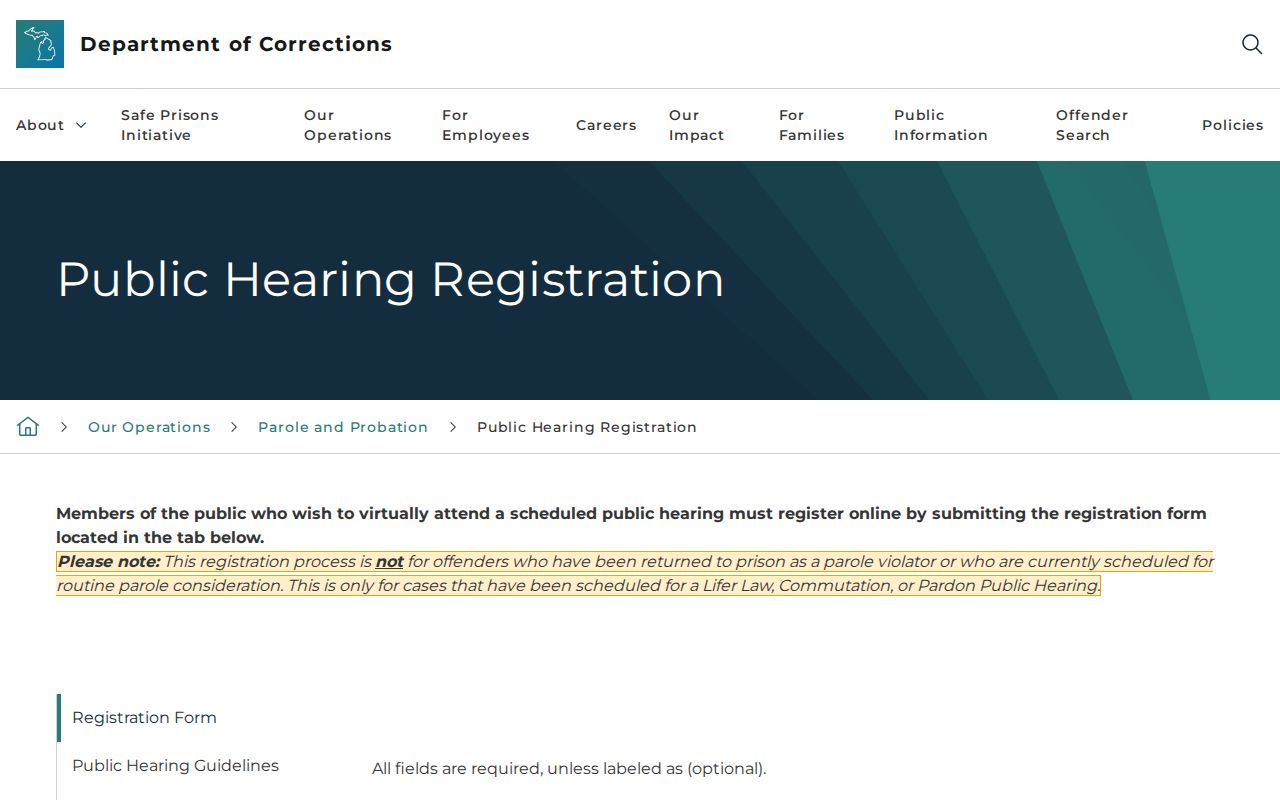
Ordinary interview results are not exposed there as a person-searchable database. Return to OTIS for a later DATE PAROLED or status change, or use the Parole Release Unit when an official individual answer is needed.
Property After Menominee Release
The Menominee County Jail forms and documents page links the March 2025 rules that create a specific post-release issue. The jail gives photocopies of most incoming letters and images to the inmate, while original documents are placed with the person’s stored belongings. Those originals are returned at release. If an item appears to be missing, use the official jail contact route with the person’s name, booking details, and approximate release date, then ask about the property record.
This property question is separate from parole and probation. A supervising agent does not become the custodian of the jail’s property form merely because supervision follows release. The jail page publishes no post-release pickup deadline, so do not assume a fixed grace period. Ask staff what the existing record shows and what authorized retrieval method applies.
The same distinction helps with identity documents. A release packet or property return may aid the person after custody, but it does not prove MDOC discharge. OTIS status, the parole order, and the later discharge record remain the right sources for that legal question.
Note: Bring enough booking detail for staff to identify the custody episode, but do not send sensitive personal data through an unsecured channel.
Menominee Supervision Discharge
Parole often continues after prison exit. MDOC’s overview says supervision is commonly one to four years, but the individual parole order controls. Probation follows its sentencing order. Successful completion, maximum expiration, revocation, a new sentence, or another court or agency action can change the path. Only the official record can establish the end date for the specific case.
In OTIS, DISCHRG means the person is no longer under MDOC jurisdiction for the shown sentence. MDOC warns that discharge can result from successful completion, maximum expiration without parole, or death before completion. The label alone must not be restated as a living community release. Read the sentence detail, date, and court record together.
OTIS public coverage can end three years after the latest MDOC discharge and may end sooner after a set-aside or expungement. Older state records may require an MDOC records request. A missing result can also reflect spelling, an incomplete key, or a case outside MDOC. It never proves that no supervision existed. The 95A District Court and 41st Circuit Court records remain important for probation discharge, while MDOC remains the authority for its parole and state-supervision history.