
Menominee Projected and Actual Dates
A projected or eligibility date is a calculated point based on the sentence and governing rules. It can mark when a decision-maker first has authority to consider release, or an outside date on a sentence. An actual release date records what occurred. These are not interchangeable.
A Menominee County pretrial detainee has not begun serving a final jail or prison sentence merely because the person is held. Release may depend on bond, a court order, dismissal, transfer, or later sentencing. A sentenced county-jail prisoner may have an internal jail calculation. A person sentenced to MDOC custody has state sentence and parole fields.
The actual Menominee County jail movement entry should be paired with the court order. For state prison, `DATE PAROLED` directly records a parole exit when present, while parole supervision can continue after that day.
Find a Menominee Inmate Release Date
First identify the custody system. A county sentence and an MDOC prison sentence use different calculations, records, and offices. The Menominee County released-inmate guide can help when the last custodian is unclear.
- Read the Menominee court register and judgment to identify pretrial status, sentence terms, jail credit, and whether terms run together or in sequence.
- For a county-jail sentence, call Menominee County Jail at 906-863-4441 and ask which public record can confirm the individual calculation.
- For a state prisoner, open MDOC OTIS and search by MDOC number when possible.
- Match the name, identifiers, sentencing county, convictions, photo, and status before using a date.
- Copy the date label exactly, including `PAROLE BOARD JURISDICTION DATE`, `MAXIMUM DATE`, or `DATE PAROLED`, and record the access date.
- Ask MDOC for the time-computation record when an official individual calculation is needed.
OTIS is not a Menominee County Jail archive. A short local stay may never appear. Conversely, county jail staff cannot certify an MDOC sentence computation merely because the case began in Menominee County.
Menominee County Jail Good Time
MCL 51.282 is the starting rule for an eligible person sentenced to county jail. It describes a good-behavior reduction commonly stated as one day for every six days of the sentence. The statute and the individual jail computation control.
Do not simply subtract one-seventh from a sentence. The result can depend on the sentence start, court-ordered jail credit, concurrent or consecutive terms, eligibility, disciplinary forfeiture, new court orders, and holds. A pretrial stay also is not converted into a projected date merely by applying a county good-time formula.
The 95A District Court handles misdemeanors and adult arraignments, while the 41st Circuit Court handles felony and general-jurisdiction criminal cases. The right court order may supply the sentence and credit information, but the jail’s record is still needed for the movement itself.
Why Menominee Release Dates Change
A displayed or calculated date can change for a lawful reason without the earlier record having been fabricated. Identify the factor and the agency that controls it rather than guessing from a changed screen.
| Factor | Possible effect | Best record |
|---|---|---|
| Jail credit or sentence correction | Changes the time credited or controlling term. | Amended judgment and time computation. |
| Concurrent or consecutive terms | Changes how multiple sentences combine. | Judgment and MDOC calculation. |
| Applicable discipline or credit loss | Can alter a county or legacy-credit calculation. | Agency disciplinary and computation record. |
| Parole grant, denial, or continuance | Moves actual release beyond first eligibility. | Parole decision and OTIS status. |
| Suspension or rescission | Can stop an expected parole release before exit. | MDOC notice or parole order. |
| New sentence, warrant, or detainer | May keep the person in custody or cause transfer. | Court, jail, and receiving-agency records. |
| Data correction | Revises a public field without a new custody event. | Current OTIS and MDOC records response. |
A maximum date is not always the date a person must remain confined until. Likewise, parole eligibility does not compel the Michigan Parole Board to grant release.
Confirm a Menominee Release Date
Michigan VINELink can provide custody-status notifications tied to participating agencies. Menominee County’s jail page specifically describes release, transfer, and escape alerts and lists 800-770-7657. A user must search the correct person and complete registration. A search alone does not necessarily create an alert.
The VINELink Release Check explains how to match the agency and complete telephone, email, or text confirmation. Treat an alert as prompt notice, then confirm the event with the jail, MDOC, or court. VINE is not a certified sentence computation.
For an MDOC prisoner, compare the OTIS status and date fields after an alert. `PAROLE` means release from prison under supervision. `DISCHRG` means MDOC jurisdiction for the shown term has ended, but MDOC warns that the label can reflect more than one circumstance. Read the full record.
MDOC Dates for Menominee Cases
OTIS traces people who entered Michigan Department of Corrections jurisdiction or supervision after a Menominee County case. The search accepts last and first names, offender or MDOC number, sex, race, age, status, and marks, scars, or tattoos. The MDOC number is the strongest exact-person key and overrides other criteria.
The `PAROLE BOARD JURISDICTION DATE` is the field MDOC describes as the Earliest Release Date. It marks when the Board first has jurisdiction to consider release. It is not a scheduled exit. `MAXIMUM DATE` is a legally computed outside date on the controlling sentence. `DATE PAROLED`, if shown, is the actual date the person left prison on parole.
The OTIS search screen shows why the exact state labels and status filters matter.
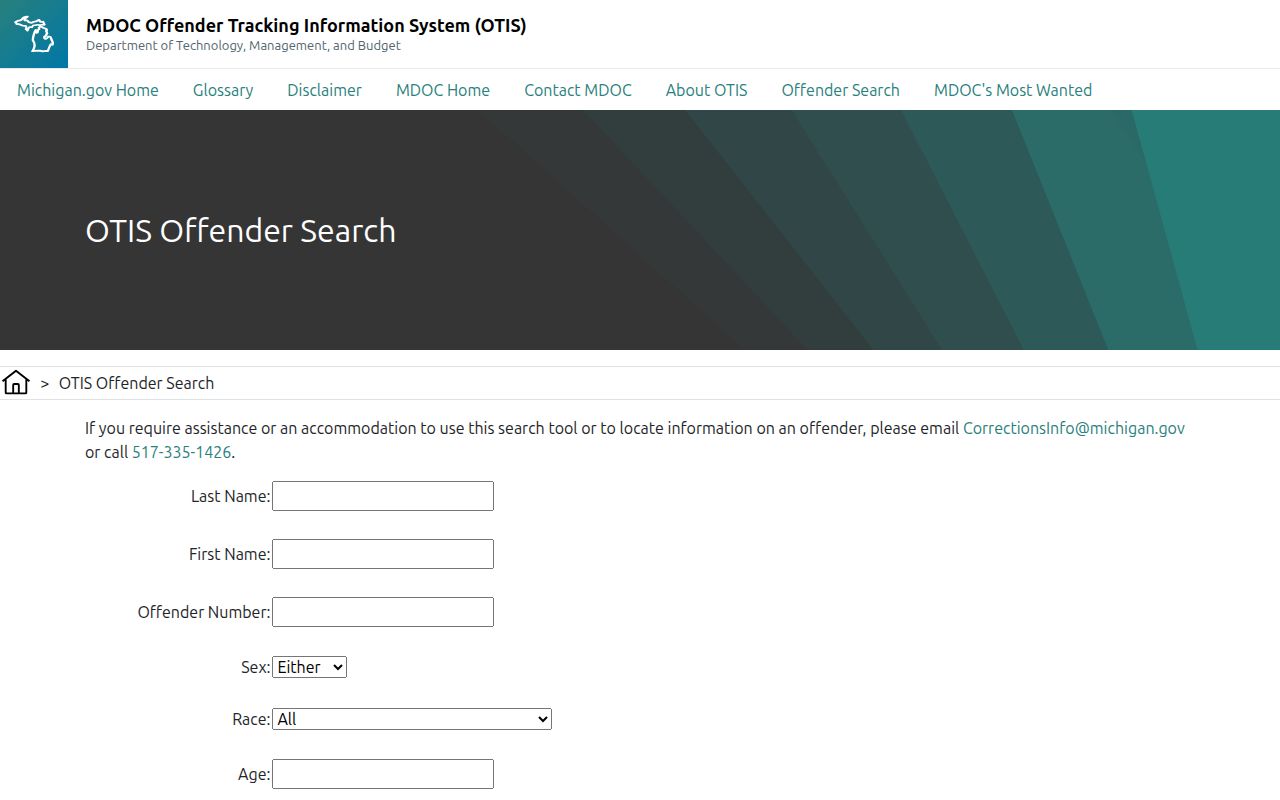
Use the image as interface context only. An individual record must be matched by reliable identifiers and read live.
Michigan Has No Universal 85% Rule
Michigan’s modern truth-in-sentencing framework generally requires the judicial minimum term before parole eligibility for specified assaultive crimes committed on or after December 15, 1998, and other crimes committed on or after December 15, 2000. In those cohorts, ordinary good-time or disciplinary credits do not reduce the judicial minimum.
A universal “serve 85 percent” shortcut is wrong for Menominee County and Michigan state cases. The ordinary modern minimum is served at 100 percent before Board jurisdiction. The federal 85-percent shorthand and rules from other states should not be imported into an MDOC calculation.
MCL 791.234 supplies the main parole-eligibility framework, while MCL 791.233 addresses parole release conditions. MCL 800.33 and MCL 791.233b preserve distinct credit regimes for legally defined older offense cohorts. Offense date can change the rule completely.
Menominee Release Computation Limits
Menominee County publishes no standard local release hour and no weekend-advance policy. A county calculation therefore begins with MCL 51.282, the judgment, jail credit, and the jail’s individual computation. A state-prison calculation begins with MCL 791.234, the judgment, OTIS, and MDOC’s time record.
These paths should not be blended. County good time does not rewrite a later MDOC prison minimum. An OTIS eligibility field does not predict the physical departure time from Menominee County Jail. A parole decision can also be deferred, denied, suspended, or rescinded before release.
Note: Ask the responsible agency for its official calculation instead of performing sentence arithmetic from a public summary.
Obtain Menominee Date Records
For a county jail record, Menominee County directs written FOIA requests to County Administration. Ask for the existing booking and release entry, jail-credit or release calculation record if maintained and public, and transfer destination if recorded. FOIA does not require the county to create a projected date or answer a calculation question.
For an MDOC record, use `MDOC-FOIA@michigan.gov`. Identify the person by MDOC number and request the specific time computation, parole order, discharge record, or status history. MDOC’s public contact material also lists a past-prisoner records route for a limited period after release.
The court file completes the chain. A Menominee judgment shows the legal sentence and ordered credit; the agency computation applies the governing rules; and the movement or parole date proves the event that actually occurred.
Menominee County’s FOIA page describes an initial response within five business days after receipt and one possible extension of no more than ten business days. That deadline governs the agency response, not the sentence calculation or release date. Request an electronic copy, reasonably segregable parts, and an itemized fee estimate when appropriate.
Parole Dates in Menominee Records
Parole is release from a state prison sentence to MDOC supervision. It is not the same as bond from Menominee County Jail, probation imposed by a court, or final discharge from MDOC jurisdiction. A person may be physically out of prison yet remain under a parole order for years.
The Michigan Parole Board decides parole matters under state law. Eligibility under MCL 791.234 only places the case within the Board’s authority. The Board may grant, deny, or defer action. A favorable action can later be suspended or rescinded because of misconduct or adverse information before the planned exit.
The CAX-119 Parole Order issued before release states the parole date, term, and conditions. OTIS may then show `DATE PAROLED` and a `PAROLE` status. Those records are stronger evidence of actual prison release than an eligibility date or an announced interview. A public hearing notice is also not a grant.
Read Menominee OTIS Status Literally
OTIS status terms prevent a common release-date error. `PRISON` means MDOC prison custody. `PAROLE` means the person has left prison but remains under MDOC. `PROB` means MDOC-supervised probation. `DISCHRG` means the person is no longer under MDOC jurisdiction for the shown sentence.
MDOC cautions that discharge can result from successful completion, maximum expiration without parole, or death before completion. The word alone is not proof of a living community release. Read sentence details, parole dates, and the full status history rather than translating every discharge into the same event.
Public OTIS coverage generally ends three years after the latest MDOC discharge and may end sooner after a set-aside. An absent older result may reflect coverage rather than the lack of a sentence or release. Past-prisoner records should be requested through MDOC’s documented records channels.
Holds After a Menominee Date
A date on one case does not cancel authority in another. A warrant, detainer, consecutive sentence, federal process, immigration matter, or another jurisdiction’s order can cause continued custody or transfer. The county jail’s release entry may therefore mark the end of Menominee authority without marking freedom from all custody.
Ask the jail for the destination or receiving agency if that field is recorded and public. Follow a state transfer in OTIS, a sentenced federal case in the BOP locator and federal docket, and a possible immigration transfer in ICE’s locator. Do not call any of those a Menominee community release unless the records support it.