
MDOC Menominee Release Paths
No MDOC prison was identified within Menominee County. MDOC appears in the local release trail because a person sentenced to state prison may leave Menominee County Jail by transfer. County authority ends, but state custody starts. The assigned reception center or institution can change, so a search should follow the location and status shown by MDOC rather than a guessed nearby prison.
Later, parole may take the person from prison into the community under conditions. The Michigan Parole Board makes parole decisions, and MDOC’s Field Operations Administration provides supervision. Discharge is a different endpoint. It generally means the person is no longer under MDOC jurisdiction for the displayed sentence, though MDOC warns that its discharge status can also reflect maximum expiration or death before completion. Read all fields together.
| MDOC event | Custody meaning | Best confirmation |
|---|---|---|
| County-to-MDOC transfer | State custody begins; no community release occurred. | Jail movement record plus OTIS |
| PAROLE | The person left prison but remains under MDOC supervision. | OTIS DATE PAROLED and parole order |
| PROB | The person is under MDOC-supervised probation imposed by a court. | OTIS and court probation order |
| DISCHRG | The displayed MDOC obligation ended by a qualifying event. | OTIS details and MDOC discharge record |
Search MDOC Menominee Releases
The official Offender Tracking Information System, known as OTIS, covers people within MDOC jurisdiction or supervision and qualifying recent historical records. It is not a Menominee County Jail archive. A short local detention that never entered state corrections may never appear.
- Accept the OTIS notice and search by MDOC number when it is known. That unique number overrides other criteria.
- If no number is available, enter the surname and given name, then narrow with age, sex, race, status, or other offered fields.
- Compare the name, aliases, age or birth data, photograph, MDOC number, convictions, and sentencing county before selecting a record.
- Read status and location literally. Prison, parole, probation, absconder, and discharged are not interchangeable.
- Open sentence and parole details. Save the exact field label, associated date, sentence, and access date.
- For a person outside prison, distinguish DATE PAROLED from discharge or maximum-date information.
When the custody system itself is unclear, the Menominee County released-inmate records path starts with the last agency known to hold the person.
MDOC Release Search Fields
The captured OTIS search view is the matching state source for a Menominee County case that reached MDOC. It supports both exact-number and filtered name searches, including a discharged-status route.
Open the official MDOC OTIS offender search.
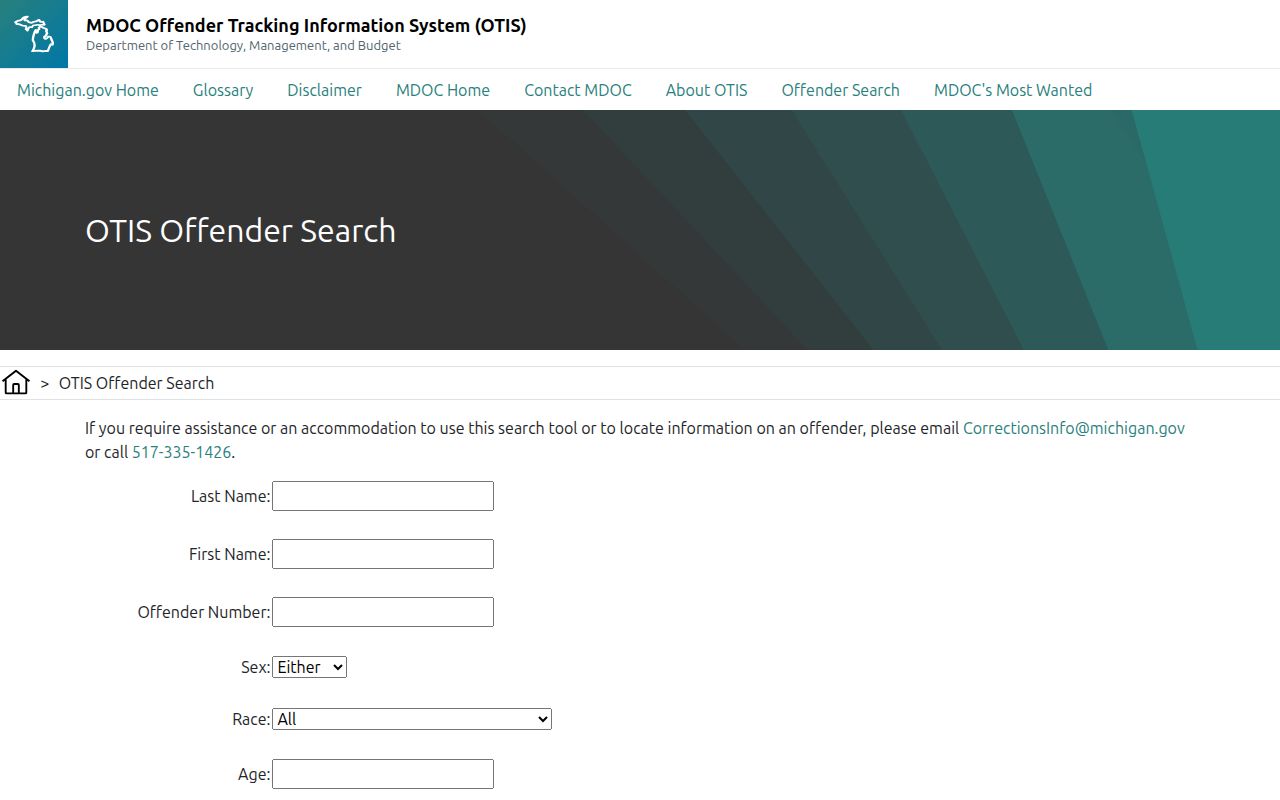
The form helps locate the record, but the selected result must still be checked against identity and sentence details. A common name alone is weak evidence.
| OTIS field | Use | Limit |
|---|---|---|
| MDOC number | Preferred exact-person identifier | Must belong to the intended person |
| Offender status | Filters prisoners, parolees, probationers, discharged people, and absconders | Status is only one part of the record |
| Location or supervision | Shows the institution or supervision place supplied by MDOC | May change |
| DATE PAROLED | Shows the actual prison-to-parole date when present | Not the end of supervision |
| PAROLE BOARD JURISDICTION DATE | Earliest point for Board jurisdiction | Not a promised release date |
| MAXIMUM DATE | Potential outside date as legally calculated | Does not predict the actual exit |
MDOC Release Status Terms
OTIS status codes carry agency-specific meanings. PRISON means MDOC prison custody. PAROLE means prison release under continuing MDOC legal custody and community supervision. PROB marks MDOC-supervised probation. DISCHRG says the person is no longer within MDOC jurisdiction for the shown obligation. An absconder status alleges failure to remain available or comply with supervision and must not be restated as discharge.
- Parole
- Conditional community release after state imprisonment, under MDOC supervision.
- Probation
- A court sentence served in the community under stated conditions, sometimes supervised by MDOC.
- Discharge
- The endpoint of the MDOC obligation displayed, not simply the day prison custody ended.
- Absconder
- A supervision status indicating the agency alleges the person is unavailable or noncompliant.
The status filter offers Active Offenders, All, Prisoners, Parolees, Probationers, Discharged, Parole Absconders, and Probation Absconders. If OTIS shows a Menominee supervision location, the MDOC supervision office directory can identify the current office. Do not infer private reporting terms, residence, treatment, or agent details from a public status.
Note: Record OTIS wording exactly because “paroled,” “discharged,” and “not in prison” answer different questions.
MDOC Menominee Release Dates
Michigan does not use a universal 85 percent formula for every MDOC prisoner. Modern truth-in-sentencing generally requires service of the judicial minimum before parole eligibility. MDOC describes phased implementation for specified assaultive crimes committed on or after December 15, 1998, and other crimes committed on or after December 15, 2000. People in those modern groups do not receive a general credit that reduces the judicial minimum.
OTIS calls the main eligibility field PAROLE BOARD JURISDICTION DATE and explains it as the Earliest Release Date. That is the date when the Board first gains authority to consider release, not a scheduled exit. MCL 791.234 supplies the eligibility framework, while MCL 791.233 addresses parole release requirements. Older offense groups can fall under MCL 800.33 or MCL 791.233b credit rules, so offense date can change the calculation.
A displayed date can shift because of sentence correction, jail-credit changes, consecutive terms, a parole grant, denial, or continuance, rescission, a new sentence or detainer, or data correction. Never calculate an individual date from sentence length alone. The judgment and MDOC time computation control.
Request MDOC Release Records
Public OTIS coverage is time-limited. It includes current prisoners, parolees, probationers, interstate-compact cases, escapees or absconders, and people discharged within three years of their latest MDOC jurisdiction or supervision. A record may leave public view sooner after a set-aside or expungement. Thus, a missing older result may reflect coverage rather than the absence of an MDOC history.
MDOC lists records and FOIA contacts for the next step. Past-prisoner records up to six years after release may be routed to MDOC Records Retention, while formal requests use MDOC FOIA. A focused request can identify the person by MDOC number and seek an existing parole order, discharge certificate, status history, time-computation record, public photograph, or specified PENPACK component.
County Administration cannot produce a state record it does not possess. Conversely, MDOC is not the source for a county-jail-only release entry. If Menominee County Jail transferred the person to MDOC, the county movement record establishes the handoff, while state records show what happened during and after the prison term.
Michigan Department of CorrectionsGrandview Plaza
206 E. Michigan Avenue / P.O. Box 30003
Lansing, MI 48909
General telephone: 517-335-1426
Hours: Monday–Friday, 8:00 a.m.–5:00 p.m. Eastern
MDOC Menominee Supervision Record
After prison release, OTIS may show PAROLE and a place of supervision. MDOC’s Region 1 directory identifies a Menominee County Parole and Probation Office at 1000 9th Street, Menominee, MI 49858, telephone 906-863-4705. Use that office only after the public state record indicates Menominee supervision. Boundaries and agent assignments can change.
The Michigan Parole Board can grant, deny, defer, suspend, or rescind parole action under its process. A favorable step before release is not the same as actual release. DATE PAROLED and the parole order are stronger proof that prison custody ended. The order states the parole date, term, and conditions, while a later discharge closes the MDOC obligation if properly recorded.
Probation has a different origin. It is imposed by a court and may follow a county case without state imprisonment. The 95A District Court handles local misdemeanor matters, while the 41st Circuit Court handles felony matters. Read the probation order or discharge in the correct case, then use OTIS for the public MDOC supervision status.
MDOC Release Search Limits
A negative OTIS result has several possible causes: a misspelled name, a record outside MDOC scope, a county-jail-only episode, an older discharge beyond public coverage, a set-aside, or a search mismatch. It does not prove that the person was never held or never sentenced. Search spelling variants and identifiers before moving to records.
An OTIS photograph is a state corrections image, not the Menominee County booking photograph. Dates also require care. Maximum Date is not necessarily the actual release date, and Parole Board Jurisdiction Date is not a promise. DATE PAROLED documents prison release to parole where present, while the status and later discharge information show whether MDOC jurisdiction continued.
The state-prison record is strongest when identity, status, date label, and sentence all agree. Preserve the access date and exact words. For an official individual calculation or a missing historical record, request the agency’s existing record rather than making an estimate.